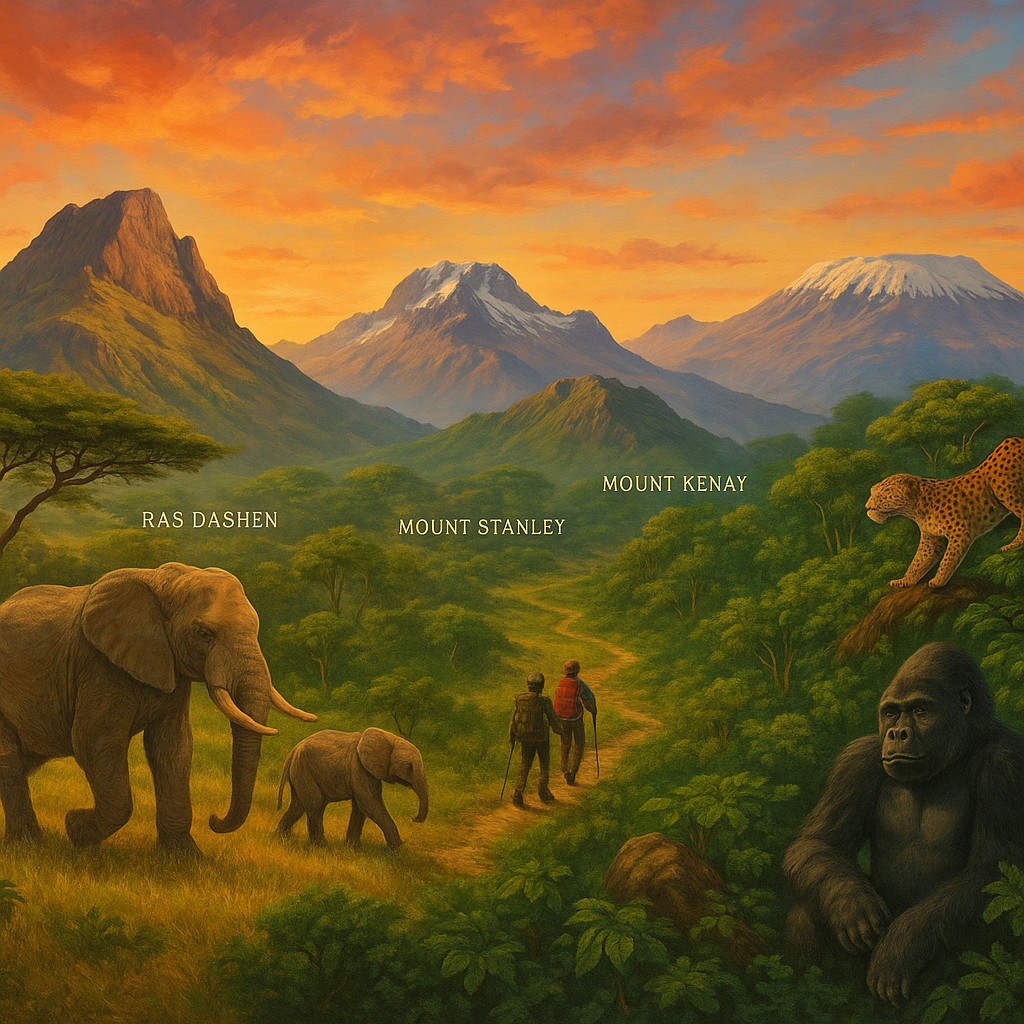
Endless savannas, indigenous tribes, a palette of colors ranging from amber sand to emerald jungles — Africa captivates from the very first moment. Among the continent's natural treasures, five giants stand out, attracting climbers from all over the world. From the relatively calm Ras Dashen to the legendary Kilimanjaro, here is a short but intense expedition to the highest peaks in Africa.
Ras Dashen, Ethiopia (4,550 m)
The name of the mountain can be translated from Amharic as "commander-in-chief, led by the emperor." Despite its formidable name and height of almost 4,600 m, the climb is considered moderately easy: the route takes six to seven days, requires only basic endurance, and allows for gradual acclimatization.
The trail passes through the Simien Mountains National Park, a UNESCO World Heritage Site. During the trek, you will see terraced fields, tiny villages, and herds of galago monkeys. A well-planned tour will make your trip even more comfortable: local guides often take care of logistics, meals, and permits.

Meru, Tanzania (4,562 m)
Amidst the raging green ocean of the Rift Valley rises the cone of Meru, a dormant stratovolcano that last erupted over a century ago. The four-day trek is suitable for beginners: gentle elevation gain, rope handrails on difficult sections, and overnight stays in equipped huts.
The fauna of Arusha National Park is impressive: giant black and white colobus monkeys leap through the branches, and the silhouette of a leopard may flash through the mist. The picture is completed by a gaping crater two kilometers in diameter — the perfect place for a photo against the backdrop of the morning haze.
Stanley, Congo (5,109 m)
The grandiose Rwenzori massif has several five-thousand-meter peaks, the highest of which is Margherita Peak, part of Mount Stanley. The climb takes about a week: first, travelers traverse the humid equatorial jungle, then emerge onto alpine meadows, and finally reach the snow-capped ridges.
The route is technically not difficult, but it is challenging: there are many logs, suspension bridges, and ice bends. Tourists usually start from the Ugandan side: the infrastructure is better here, and it is easier to obtain permits. From the slopes of Virunga National Park in Congo, you have the chance to see gorillas in their natural habitat — an experience that will stay with you for a long time.
Kenya, Kenya (5,199 m)
This mountain was once taller than Kilimanjaro, but thousands of years of erosion and glacial melting have reduced its former height. Today, tourists strive to reach two main points: Batian (5,199 m) and Nelen (5,188 m). The first is best climbed from June to October, and the second from December to March.
The mountain is located in the national park of the same name; its wooded slopes are teeming with elephants, buffalo, and anubis. Travelers enjoy watching the animals from the Mountain Lodge observation deck, and the cascading waterfalls fed by melting glaciers are a special bonus.
Kilimanjaro, Tanzania (5,895 m)
Kilimanjaro is often called the "Crown of Tanzania" or the "Roof of Africa." Despite its height of almost 6,000 meters, the climb does not require professional mountaineering experience: competent organization, a slow pace, and sufficient acclimatization are the keys to success.
At the foot of the mountain are coffee plantations, and slightly higher up is a cloud belt of giant senecions. The final push through volcanic ash leads to the Kibo crater with its famous, albeit rapidly melting, snow cap. If you're not planning on reaching the summit just yet, you can spend your time on a safari in the Serengeti National Park or relaxing on the Zanzibar archipelago.
Practical tips
- Before departure, check the epidemiological situation on the WHO website and clarify whether vaccination against yellow fever is required.
- Prepare a first aid kit in advance: repellents, fever reducers, antihistamines, bandages, and band-aids are essential for traveling to the tropics.
- Only take bottled water with you, avoid ice of unknown origin, and wash vegetables and fruit with the same water.
- The average cost of a package with a guide, accommodation, and meals starts at $1,400; flights are paid for separately. The airline ticket service will help you compare fares and find the best connections.
- When planning your itinerary, don't forget to obtain your visa in advance; consulates are extremely busy during the high season.
May your African adventure be full of vivid emotions, and may the peaks be conquered easily and safely!