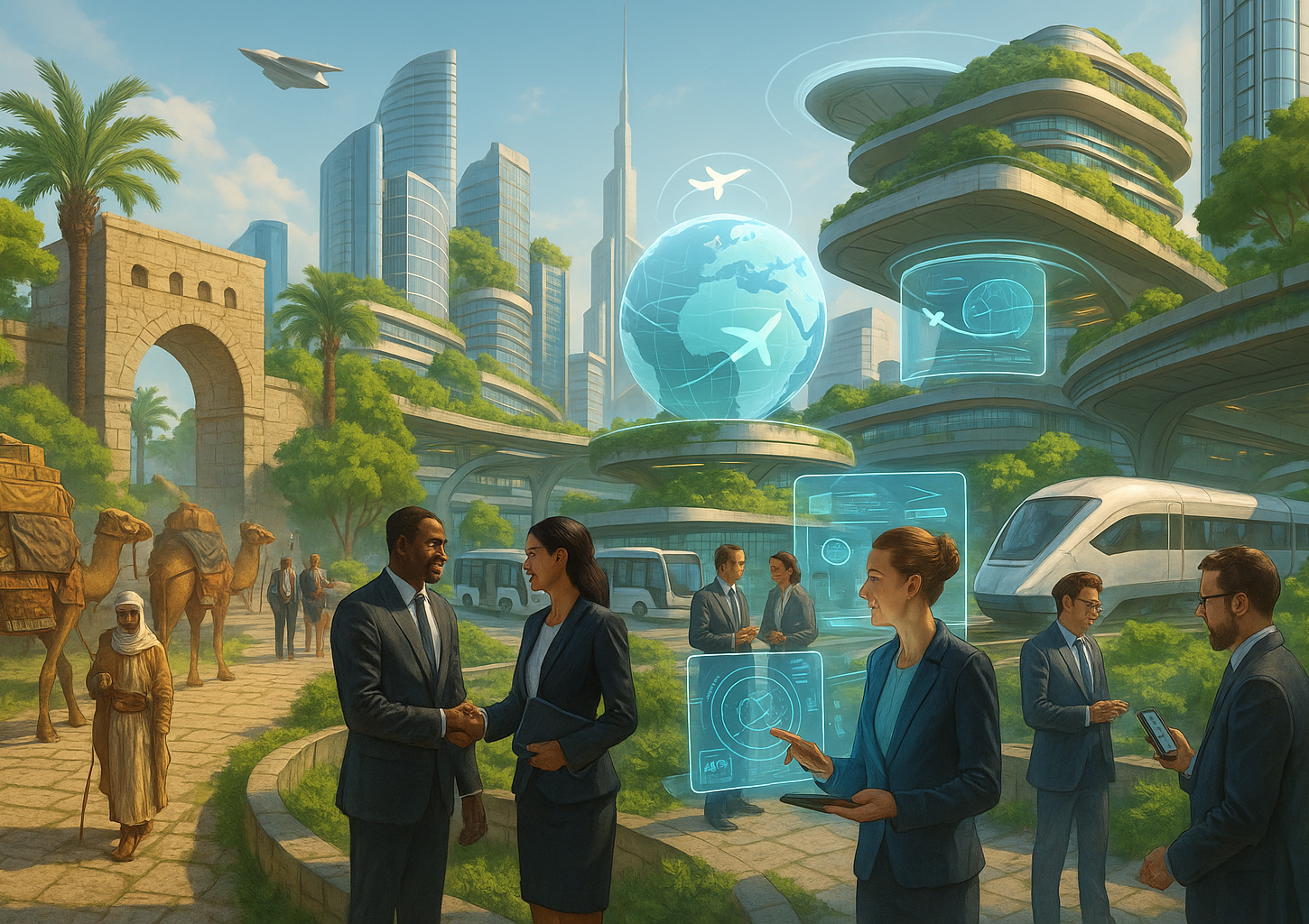
Business travel remains a powerful driver of company development: face-to-face negotiations speed up deals, participation in trade fairs opens up new markets, and study abroad enhances staff skills. Below we look at how business travel has changed over the centuries, what innovations dictate the rules of the game now, and what the industry has in store for the near future.
When planning a flight, many professionals choose airline tickets in advance to lock in a favorable fare and optimize the budget.
From caravans to online services: a brief history of business travel
Ancient civilizations
The first "traveling" people - merchants from Mesopotamia, Egypt and China - crossed deserts, seas and mountains in search of new markets. Trade routes like the Silk Road encouraged authorities to build roads, inns and warehouses. Travel times were measured in months, and safety depended on the number of armed escorts.
Middle Ages
European fairs in Leipzig, Chamonix and Novgorod became centers of economic life: craftsmen, bankers and diplomats flocked there. Caravanserais, which can be called prototypes of modern hotels, appeared: they offered food, lodging and even currency exchange. The expansion of sea routes, thanks to the compass and astrolabe, accelerated international trade.
Industrial Revolution
1807 - Robert Fulton's first commercial steamship is launched, in 1814 George Stephenson demonstrates a steam engine. The speed of travel increases tenfold. Telegraph and mail trains simplify communication, and insurance companies begin to issue the first policies for travelers.
The 20th century and the post-Soviet space
After World War II, the USA became the leader in conference entrepreneurship: it was there that the MICE (Meetings, Incentives, Conferences, Exhibitions) industry was formed. In Russia, however, mass business trips only started in the 1990s, when GDS systems and the first corporate travel agencies entered the market.
Why businesses need business travel today
- Face-to-face meetings with clients and partners to expedite contracts.
- Participation in industry exhibitions and congresses for the sake of new ideas and technologies.
- Negotiations on localization of production and entry into foreign markets.
- Training of specialists and exchange of best practices between branches.
- Team building events that increase employee loyalty and motivation.
Major forums like the World Economic Forum in Davos or Mobile World Congress in Barcelona generate billions of dollars annually for host cities, and give companies the opportunity to carve out profitable niches.
How digitalization has changed the booking process
Ten years ago, it took days to process a business trip: a manager would call the agency, wait for confirmation, reconcile the invoices and manually enter the data into the accounting system. Today, all you need to do is log in to a web office, select a flight, hotel and payment method, and the electronic documents will automatically be entered into the ERP.
Machine learning algorithms make a significant contribution to cost optimization. They analyze purchase history, price dynamics and the status of loyalty programs, helping to choose the best option. Additionally, the business receives analytics on KPIs: average check, savings on early booking, and the percentage of rejected requests.
It's easy to find a hotel for business travel through the discount hotel booking service, which aggregates offers from 2.5 million properties worldwide.
Current trends for 2025
1. Flexibility and bleisure
Employees prefer to combine work and leisure: after the conference, they stay in the city for a couple more days to stroll through museums or go surfing. Companies that allow you to change dates get more motivated and loyal employees.
Such scenarios can be easily realized through a business travel platform where you can approve business trip extensions with a single click.
2. Increase in group outings
Teams (10+ people) can organize strategy sessions and hackathons offline. Operators give special rates for airfare and accommodation, so the final check is often lower than for individual bookings.
3. the ESG agenda and carbon footprint
80% of companies trackCO2 emissions and issue sustainability reports. Direct flights are chosen, chains with a train instead of an airplane, and the difference is made up by planting trees or investing in green energy.
4. Transparency of costs
CFOs demand to see the economic impact of each flight. Modern systems visualize the value of meetings: for example, the contribution to revenue, the number of contracts signed or the partner's NPS.
Budget saving tools
- Dynamic budgeting. The limit changes depending on the destination and season, which gives real, not average, savings.
- Cashback from suppliers. Hotels and airlines return up to 5% to the company's account if the turnover reaches an agreed threshold.
- Automatic upgrades. Accumulated miles and statuses are converted into business class or early hotel check-in.
- Smart route optimization. The system selects connections taking into account cost, visa requirements and time windows.
When traveling long distances, employees choose business class airline tickets, which increases productivity during negotiations due to comfortable rest on the way.
Company cases
"We reduced the average cost of a ticket by 18% after switching to a single booking system. The approval process now takes less than an hour."
- Financial Director of IT Holding
"The touchless check-in feature has saved employees from queuing at reception. We save up to 3 hours of working time per check-in."
- HR manager of a pharmaceutical company
Check-list for effective business travel
To make the most of your trip, follow a simple pattern:
- Define KPIs (revenue, meetings, training).
- Agree on budget and limits before booking.
- Choose the best transportation withCO2 in mind.
- Book a hotel closer to the venue.
- Prepare reports and materials in advance.
- After the trip, file a report on the results and costs.
If you need to change round-trip dates, it's most convenient to use flexible-date airline reservations - tickets can be rescheduled without penalty.
The future of business travel
Experts predict the growth of VR and AR services for virtual inspections of factories and sites. But they will not be able to completely replace face-to-face meetings: trust and emotional contact are still born offline. Most likely, the model will be hybrid - combining remote work and point-to-point business trips.
Beyond technology, people will remain key: well-designed itineraries, healthy in-flight meals and 24/7 support. It is this human-centered approach that will give the company a reputation as a dream employer.
Full-service, from visa to advance refunds, provides a business travel service that is accessible to teams of any size.
Conclusions
Business tourism has gone from spice caravans to smart ecosystems where a couple of swipes are enough to book flights, rooms and transfers. In 2025, companies that seek a balance between economy, employee care and sustainability are winning. Invest in technology solutions, track metrics and don't be afraid to experiment with travel formats so that every business trip becomes an asset, not an expense line.