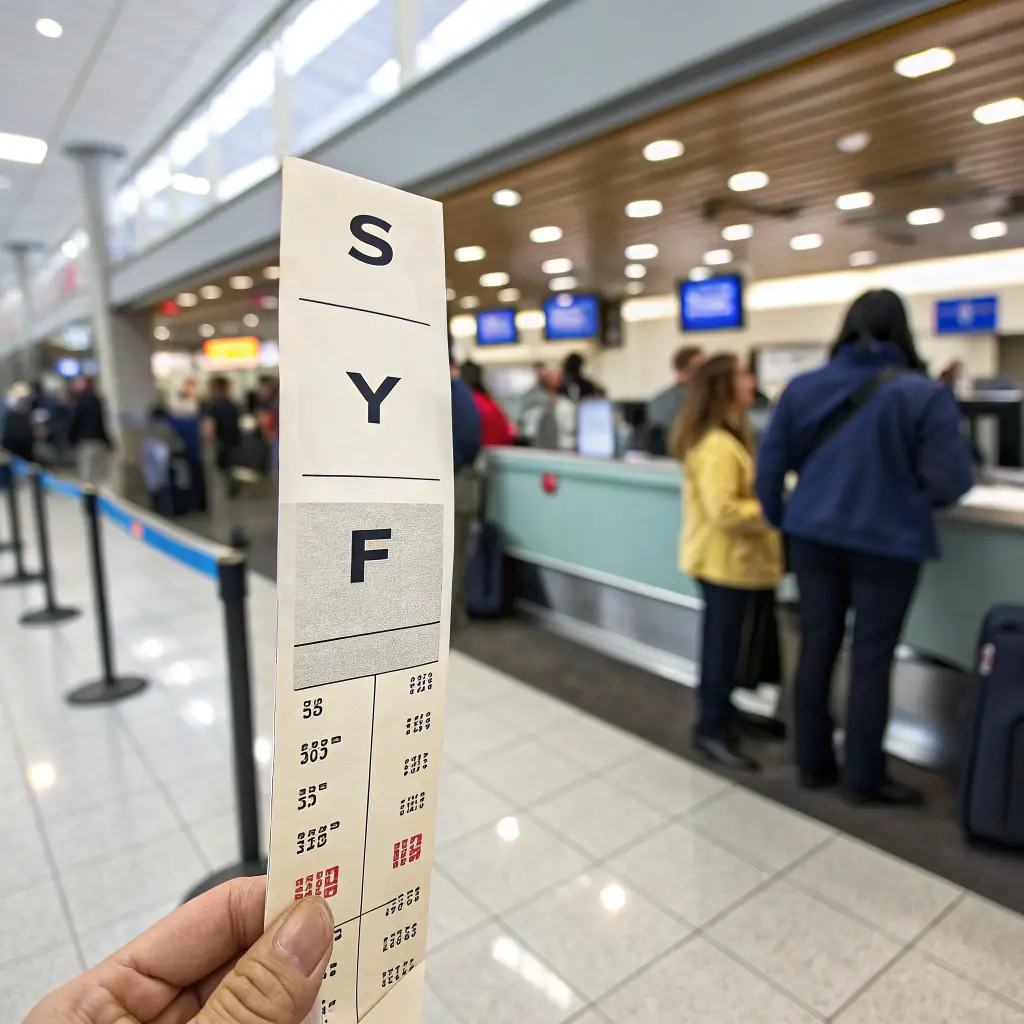
How to understand the letters on your ticket, how they differ from service classes, and why they affect the price and flexibility of conditions.
The Latin letter on your airline ticket is not just a symbol, but a short formula that the airline uses to determine the price, set of services, and rules for using your fare. At the same time, booking classes are often confused with service classes (economy, business, first), although these are different things. Let's figure out how the letter code system works and why two passengers sitting next to each other can pay completely different amounts for the same flight.
What is a booking class?
A booking class is a letter assigned to a specific seat quota. The letter indicates:
- tariff cost;
- service options package: baggage, meals, priority;
- return and date change policy;
- presence or absence of bonus miles.
For example, a Y class ticket may allow free returns, while a T class ticket in the same economy cabin will be non-refundable and without baggage allowance.
Connection with service classes
Each letter code is "linked" to one of three service classes, but the boundaries within the range are huge. Business class can include six or seven fare subcategories, and economy class can include more than a dozen. That is why tickets of different prices can be found within the same cabin.
Main groups of letter codes
First grade
F — base fare;
A — discounted first class;
P — premium product with upgraded seats and additional services;
R — rare "supersonic" code, historically associated with the Airbus A380.
Business class
C — standard;
J — premium business with increased mileage accrual;
I, D, Z — promotional or corporate offers.
Economy class
W — premium economy;
S, Y — full price with maximum flexibility;
B, H, K, L, M, N, Q, T, V — tickets with varying discounts;
G, X — group quotas;
E — charter without advance booking, confirmation only at check-in;
U — similar option, but with a seat guarantee.
Why the same letter does not always mean the same thing
The letter set is not fully standardized: each airline has the right to set its own conditions. With one carrier, class Y is refundable without penalty, while with another, it is a non-refundable fare. Therefore, it is important to read the rules for a specific ticket before purchasing.
How class affects price
The lower the price, the stricter the restrictions: most often, you cannot return the ticket, change the dates, or check baggage for free. However, promotions allow you to find cheap airline tickets without compromising on safety.
Helpful tips before buying
- If you need flexible dates, choose fares with the option to change or the "Booking flights with flexible dates."
- For business trips, check out B2B travel solutions — they allow you to control expenses and prepare reporting documents.
- When planning a complex route, use the services "Online Air Tickets" services: this makes it easier to compare dozens of fares.
- Comfort before and after your flight is guaranteed booking luxury hotels near the airport.
- Don't forget that business travel management services will help you save time on coordinating business trips.
Results
The letter on the ticket is a clue about the price and rules. Cheap options do not offer flexibility, while expensive ones remove restrictions. Read the terms and conditions, compare fares, and choose the best code for your needs.